
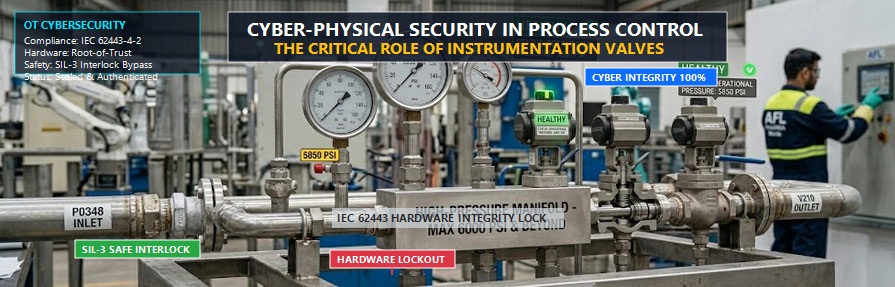
As industrial systems evolve toward smart, connected architectures, security risks are no longer limited to cyber networks alone. Modern process plants operate as cyber-physical systems, where digital intelligence directly influences physical operations. In this environment, a security breach can have real-world consequences—process disruption, equipment damage, environmental incidents, or safety hazards.
While cybersecurity discussions often focus on software, networks, and control systems, physical components such as instrumentation valves play a critical but underappreciated role in cyber-physical security. These valves form the physical boundary between digital control decisions and process reality.
Understanding their role is essential to building resilient, secure smart process control systems.
What Is Cyber-Physical Security in Process Industries?
Cyber-physical security refers to the protection of systems where computational elements control physical processes. In smart plants, sensors, controllers, and actuators interact continuously with mechanical equipment.
Cyber-physical security aims to:
- Protect digital systems from unauthorized access
- Prevent manipulation of physical processes through cyber means
- Ensure safe system behavior even during cyber incidents
- Maintain operational integrity under abnormal conditions
- Unlike traditional IT security, cyber-physical security must account for both digital threats and physical consequences.
Why Smart Process Control Expands the Threat Surface
Smart process control relies on real-time data, automated decision-making, and remote connectivity. These capabilities improve efficiency but also expand the attack surface.
Key factors include:
- Increased connectivity between field devices and networks
- Remote access for monitoring and maintenance
- Integration of analytics and automation platforms
- Reduced human oversight in routine operations
- In such environments, the physical layer must be robust enough to prevent digital compromise from escalating into physical harm.
| Security Layer | Target Threat / Attack Vector | Physical Hardware Mechanism | Industry Standard Compliance |
|---|---|---|---|
| Physical Access Lockout | Unauthorized field manipulation of valve position | Tamper-evident keyed lockout & security wire | OSHA 1910.147 / ISO 14159 |
| Mechanical Boundary | Malicious digital override of process pressure | Mechanical pressure relief & spring-return bypass | IEC 61511 / SIL-3 Certified |
| Sensor Root-of-Trust | Sensor spoofing & false DP signal injection | Cryptographic hardware authentication on transmitter | IEC 62443-4-2 / NIST SP 800-82 |
| Dual Process Isolation | Cross-unit cascade failure during cyber event | Double Block & Bleed (DBB) manifold architecture | ASME B16.34 / API 598 |
The Traditional Role of Instrumentation Valves
Instrumentation valves—such as manifold valves—have historically been treated as purely mechanical components. Their core functions include:
- Isolating instruments from live process pressure
- Equalizing pressure during calibration
- Venting pressure safely during maintenance
- Protecting sensors and transmitters
- These functions were designed for operational safety, not cybersecurity. However, in smart systems, they now contribute indirectly to cyber-physical resilience.
- From Mechanical Safety to Cyber-Physical Defense
- In cyber-physical systems, safety and security are tightly linked. A cyber incident that causes incorrect valve actuation, pressure misreading, or delayed isolation can lead to physical consequences.
Instrumentation valves act as:
- Physical safeguards that limit the impact of incorrect digital commands
- Fail-safe boundaries between process pressure and control systems
- Stability elements that prevent rapid escalation during abnormal events
- Their mechanical integrity provides a layer of defense when digital controls are compromised or unreliable.
- Why Instrumentation Valves Matter During Cyber Incidents
Cyber-Physical Architecture in Smart Process Control Systems
Smart process control systems operate through tightly coupled cyber and physical layers. Digital platforms analyze sensor data and issue control decisions, while physical components execute those decisions in real time.
A typical cyber-physical architecture includes:
- Physical layer: process equipment, sensors, instrumentation valves
- Control layer: PLCs, DCS, and safety systems
- Network layer: industrial communication protocols and gateways
- Supervisory layer: SCADA, asset monitoring, analytics platforms
Instrumentation valves sit at the boundary between cyber intent and physical reality. Their behavior determines whether digital commands translate into controlled process action or uncontrolled physical response.
How Instrumentation Valves Act as Physical Security Boundaries
Unlike software controls, instrumentation valves provide non-network-dependent protection. Their mechanical function remains effective even if digital systems are compromised or unavailable.
In cyber-physical security terms, instrumentation valves act as:
- Physical isolation points that limit process exposure
- Mechanical barriers against unintended pressure transmission
- Fail-safe elements during control system malfunction
- Manual override points during cyber incidents
- This makes them essential components in layered defense strategies for smart plants.
Threat Scenarios Where Valve Integrity Matters
Cyber-physical threats do not always involve direct manipulation of valves. Often, the risk arises from corrupted data, delayed commands, or incorrect control logic.
Typical threat scenarios include:
- False pressure readings causing incorrect control action
- Loss of communication between sensors and controllers
- Unauthorized modification of control parameters
- System latency during cyber incidents
Configuration Selection and Security Implications
The configuration of instrumentation valves influences how effectively a system can contain abnormal conditions.
In secure process control, configuration choice is driven by risk containment, not just measurement needs.
Supporting Fail-Safe Operation During Cyber Events
Reducing Cascade Failures Through Mechanical Stability
Cascade failures occur when an initial fault propagates through interconnected systems. In cyber-physical environments, unstable instrumentation can amplify the effects of digital errors.
Stable manifold valve performance helps:
- Damp pressure fluctuations caused by control instability
- Maintain consistent measurement signals
- Prevent rapid escalation during abnormal events
- Limit the physical impact of cyber anomalies
- Mechanical stability therefore acts as a buffer against systemic failure.
- Integration with Safety Instrumented Systems (SIS)
Preparing for Secure Smart Process Control
Cyber-physical security is achieved through layered resilience. Instrumentation valves contribute by providing physical stability, isolation capability, and manual control options that complement digital security measures.
In the next section, these principles will be translated into buyer guidance, readiness checklists, FAQs, and implementation strategies, enabling organizations to integrate instrumentation valves effectively into cyber-physical security frameworks.:
How to Strengthen Cyber-Physical Security at the Instrumentation Level
Cyber-physical security is most effective when digital protection is reinforced by physical safeguards. Instrumentation valves form a critical part of this strategy by providing mechanical control that remains reliable even when digital systems are compromised.
To strengthen cyber-physical security, organizations should:
- Identify instrumentation points where loss of control poses safety or environmental risk
- Ensure physical isolation capability independent of network commands
- Validate valve performance under abnormal or emergency conditions
- Align instrumentation design with security and safety objectives
- By treating instrumentation valves as security-relevant components, plants reduce reliance on software-only defenses.
Cyber-Physical Security Checklist – Instrumentation Valve Readiness
Use the checklist below to assess whether instrumentation valves support secure smart process control.:
Reviewing Instrumentation Valve Options for Secure Process Control
Selecting the right instrumentation valve configuration strengthens cyber-physical resilience.
Configuration references for secure applications:
Summary – Physical Resilience as a Cyber-Physical Security Pillar
Cyber-physical security in smart process control cannot rely solely on digital protection. Instrumentation valves provide mechanical stability, isolation capability, and manual fallback that help contain incidents and protect people, assets, and the environment.
By integrating valve selection into security planning, plants build layered defences that remain effective even under cyber stress.
Frequently Asked Questions (Voice-Search Optimized)
It protects systems where digital control directly affects physical processes.
They do not provide cybersecurity, but they limit physical impact during cyber incidents.
Yes. Physical isolation and venting reduce escalation during abnormal events.
Yes. Their role becomes more critical as human intervention decreases.
They enable physical isolation and pressure control independent of software.
Yes. Standardization improves predictability, inspection, and response.