
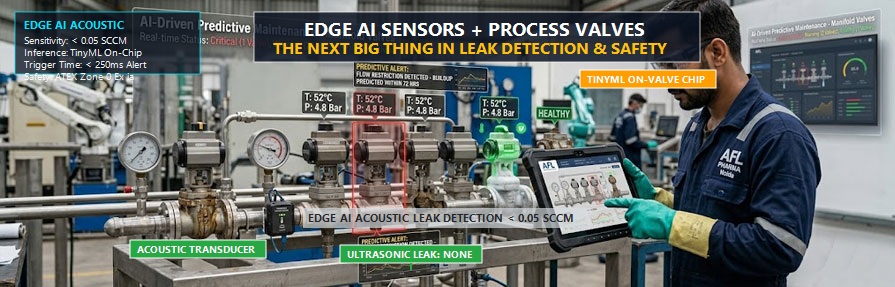
Industrial safety has traditionally relied on centralized monitoring systems, periodic inspections, and reactive alarms triggered after a threshold is crossed. While these methods have protected plants for decades, they are increasingly challenged by modern operating realities—higher pressures, complex process media, reduced human intervention, and the demand for near-zero tolerance to leaks. In this context, Edge AI is emerging as a transformative layer in industrial safety, especially when combined with instrumentation valves.
Edge AI refers to artificial intelligence that operates locally—directly at or near the sensor—rather than relying entirely on cloud or centralized control systems. When paired with sensors and valves, Edge AI enables real-time, localized decision-making that dramatically improves leak detection, response speed, and overall system safety.
This convergence of Edge AI sensors and valves represents a major shift from centralized monitoring to distributed, intelligence-driven protection.
What Is Edge AI in Industrial Process Systems?
Edge AI is the deployment of machine-learning models directly on field devices or edge controllers, allowing data to be analyzed where it is generated. Instead of transmitting raw data continuously to a central system, Edge AI processes information locally and sends only actionable insights or alerts upstream.
In industrial process systems, Edge AI enables:
- Faster detection of abnormal conditions
- Reduced network dependency and latency
- Continued operation during connectivity loss
- Context-aware responses based on local conditions
- For safety-critical applications, this localized intelligence can make the difference between containment and escalation.
Why Traditional Leak Detection Approaches Are No Longer Enough
Conventional leak detection relies heavily on threshold-based alarms—pressure drops, flow imbalances, or gas concentration levels exceeding predefined limits. While effective in obvious failure scenarios, these methods struggle with early-stage leaks and complex patterns.
Limitations include:
- Delayed detection until thresholds are exceeded
- High false-alarm rates in dynamic processes
- Difficulty distinguishing normal fluctuations from true leaks
- Dependence on centralized analysis and human interpretation
- As plants move toward higher automation and lower manual oversight, these limitations increase safety risk.
| Detection Parameter | Centralized Cloud SCADA | On-Valve Edge AI Microcontroller | Process Safety Advantage |
|---|---|---|---|
| Response Latency | 2.5 to 15 seconds (bandwidth dependent) | < 15 milliseconds localized inference | Prevents runaway pressure surge escalation |
| Offline Autonomy | Fails safe or holds last state on network drop | 100% autonomous local decision execution | Maintains safety integrity during cyber blackouts |
| Acoustic Frequency | Sub-sampled low frequency (1 Hz polling) | High-frequency ultrasonic sensing (40 kHz+) | Detects micro-fissure leakage down to 0.01 SCCM |
| False Positive Rate | High due to noisy ambient background | Trained neural network noise cancellation | Eliminates nuisance trips and costly downtime |
How Edge AI Changes Leak Detection at the Source
Edge AI transforms leak detection by analyzing patterns rather than single values. Instead of waiting for a limit to be crossed, AI models evaluate trends, correlations, and subtle deviations in real time.
Edge AI enables:
- Detection of micro-leaks before escalation
- Differentiation between process noise and abnormal behavior
- Faster local response without waiting for central validation
- Continuous learning from operating conditions
- This approach shifts leak detection from reactive alerting to predictive safety intelligence.
- The Role of Valves in Edge AI–Enabled Safety Systems
Valves are the physical gatekeepers of process containment. While sensors detect conditions, valves determine how the system physically responds. In Edge AI–enabled architectures, valves are no longer passive components—they become critical actuators in intelligent safety loops.
Their role includes:
- Rapid isolation when AI detects abnormal patterns
- Controlled venting to prevent pressure escalation
- Supporting fail-safe behavior during uncertain conditions
- Enabling localized containment independent of central control
- The combination of intelligent sensing and reliable valve action creates a powerful safety mechanism.
- Why Edge AI + Valves Improve Response Time
- One of the most significant safety advantages of Edge AI is response speed. Centralized systems introduce latency—data transmission, processing, decision approval, and command execution.
Edge AI reduces response time by:
- Processing data at the point of measurement
- Enabling immediate local decisions
- Reducing reliance on network availability
- Allowing valves to act within milliseconds
- In leak scenarios, these time savings can prevent escalation and limit consequences.
- From Centralized Safety to Distributed Intelligence
Traditional safety architectures are centralized: sensors feed data to control rooms, where decisions are made and commands issued. Edge AI introduces distributed intelligence, where each critical node contributes to safety autonomously.
This distributed approach:
- Improves system resilience
- Reduces single points of failure
- Supports safer operation during partial system outages
- Enhances scalability in large plants
- Valves operating within this framework become part of a decentralized safety network.
- Reducing Human Dependency in High-Risk Environments
- Edge AI systems are designed to operate continuously without fatigue, distraction, or delay. In hazardous environments where human access is limited, this autonomy enhances safety.
Edge AI + valve integration helps:
- Reduce reliance on manual leak detection
- Limit exposure of personnel to hazardous conditions
- Support safer night-shift and unmanned operations
- Maintain consistent safety performance
- Human oversight remains essential—but AI handles the first line of defense.
- Safety, Reliability, and Trust in Automated Decisions
- A common concern with AI-driven safety systems is trust. Edge AI addresses this by operating within defined physical constraints enforced by valves and mechanical systems.
Key principles include:
- AI detects and recommends; valves enforce safe states
- Physical limits prevent unsafe actions
- Manual override remains possible
- AI models are tuned to conservative safety behavior
- This balance ensures automation enhances safety rather than introducing new risks.
- Why Edge AI and Valves Are a Natural Fit
Edge AI and valves complement each other perfectly: AI excels at pattern recognition and prediction, while valves provide deterministic, physical control. Together, they form a closed-loop safety system that is faster, smarter, and more resilient than traditional approaches.
As plants move toward smart, autonomous operations, this combination is becoming a foundational element of next-generation safety design.
Setting the Stage for Edge AI–Driven Safety Adoption
Understanding the role of Edge AI sensors and valves is the first step toward safer, smarter process control. This technology does not replace existing safety systems—it strengthens them by adding intelligence at the edge.
In the next section, these concepts will be explored practically—examining how Edge AI is implemented, how valves are integrated into intelligent safety loops, and what engineers should evaluate when adopting this technology.
Edge AI Architecture for Leak Detection in Process Plants
Edge AI–based safety systems are built on a decentralized architecture where intelligence is embedded close to the physical process. Instead of relying entirely on centralized analytics, Edge AI processes sensor data locally and triggers physical actions when required.
A typical Edge AI leak-detection architecture includes:
- Sensing layer: pressure, differential pressure, flow, acoustic, or gas sensors
- Edge intelligence layer: embedded AI models performing real-time pattern analysis
- Actuation layer: instrumentation valves executing isolation or venting actions
- Supervisory layer: PLC/DCS receiving summarized alerts and status updates
- In this architecture, valves are not downstream accessories—they are core execution elements of the safety response.
How Edge AI Detects Leaks Earlier Than Conventional Systems
Traditional leak detection depends on static thresholds. Edge AI replaces this with behavioural analysis, learning what “normal” looks like for a specific process and identifying deviations early.
Edge AI models analyze:
- Pressure decay patterns
- Micro-fluctuations in differential pressure
- Abnormal response during valve cycling
- Correlation between flow and pressure changes
- By recognizing patterns rather than limits, Edge AI identifies leaks at an early stage—often before alarms would normally trigger.
Role of Manifold Valves in Edge AI Safety Loops
Manifold valves are particularly well-suited for Edge AI–driven safety because they directly control pressure pathways in instrumentation loops.
Their role in intelligent safety loops includes:
- Immediate physical isolation when abnormal patterns are detected
- Controlled venting to prevent pressure escalation
- Stabilizing instrumentation signals for AI accuracy
- Acting independently of central command during emergencies
Configuration relevance:
The more complex the risk environment, the more value Edge AI extracts from advanced valve configurations.
Local Decision-Making and Fail-Safe Operation
One of the strongest advantages of Edge AI is its ability to function independently of network connectivity. In safety-critical scenarios, this autonomy is essential.
Edge AI + valve systems support:
- Leak detection during network or system outages
- Immediate local containment without central approval
- Safe default behavior during uncertainty
- Reduced dependence on human reaction time
Preventing False Alarms While Improving Sensitivity
A common challenge in leak detection is balancing sensitivity with false alarms. Edge AI addresses this by learning process-specific behaviour rather than applying generic rules.
Benefits include:
- Reduced nuisance alarms
- Improved operator trust in alerts
- More targeted valve actuation
- Less disruption to normal operations
- This precision is especially important in plants where unnecessary shutdowns carry high cost.
Edge AI Integration with Existing Control & Safety Systems
Edge AI does not replace PLCs, DCS, or Safety Instrumented Systems—it augments them.
Integration typically includes:
- Edge AI providing early detection signals
- PLC/DCS maintaining supervisory control
- Valves executing immediate physical response
- Central systems logging events and analytics
- This layered approach improves safety without compromising existing compliance frameworks.
- High-Risk Application Scenarios
- Edge AI + valve integration delivers the highest value in environments where leaks escalate rapidly.
Typical scenarios include:
- High-pressure gas and hydrogen systems
- Toxic or hazardous chemical processing
- Remote or unmanned installations
- Aging infrastructure with degradation risk
- In these contexts, early detection and rapid isolation are essential to preventing incidents.
- Why Instrumentation Stability Matters for AI Accuracy
- AI models depend on high-quality input data. Unstable instrumentation caused by leakage, vibration, or valve degradation reduces detection accuracy.
Manifold valves support AI accuracy by:
- Maintaining consistent pressure reference
- Preventing signal noise from micro-leaks
- Supporting repeatable valve behavior
- Enabling reliable baseline learning
- Mechanical reliability is therefore a prerequisite for intelligent safety.
- Using a Structured Valve Portfolio for Edge AI Deployment
Preparing for Intelligent Leak Detection at Scale
Edge AI + valve integration is most successful when deployed incrementally. Plants often begin with critical loops before expanding coverage.
In the next section, these principles will be translated into buyer readiness checklists, FAQs, and adoption guidance, helping organizations implement Edge AI–enabled leak detection and safety systems confidently.:
How to Prepare Your Plant for Edge AI–Driven Leak Detection
Edge AI delivers the greatest safety benefit when implemented as part of a structured risk-reduction strategy. Rather than deploying AI everywhere at once, plants should begin by identifying process areas where leaks pose the highest safety, environmental, or financial risk.
Preparation steps include:
- Identifying high-pressure, hazardous, or remote process loops
- Evaluating existing instrumentation stability and valve performance
- Confirming fail-safe isolation capability at the field level
- Defining clear escalation paths between Edge AI and central systems
- By focusing on high-impact areas first, organizations achieve faster safety gains and smoother adoption.
Buyer Checklist – Is Your System Ready for Edge AI + Valve Safety?
Use this checklist to assess readiness for Edge AI–enabled leak detection and containment.:
Completing this checklist ensures Edge AI improves safety without introducing operational uncertainty.:
Reviewing Manifold Valve Options for Edge AI Safety Systems
Reliable valve performance is essential for Edge AI–enabled safety.
Configuration-specific suitability:
Summary – Intelligent Safety Through Edge AI and Valves
Edge AI sensors paired with reliable instrumentation valves redefine leak detection and safety by combining early intelligence with immediate physical response. This distributed, intelligent approach reduces escalation risk, improves resilience, and supports safer autonomous operation.
As industrial plants move toward smarter, lower-tolerance safety models, Edge AI + valve integration will become a foundational element of next-generation process protection.
Frequently Asked Questions (Voice-Search Optimized)
It uses local AI models to detect abnormal leak patterns directly at the sensor level.
AI detects issues; valves physically contain and isolate leaks.
It complements centralized systems by enabling faster local response.
Yes. Edge AI operates independently of cloud or central connectivity.
No. It enhances existing safety architectures.
Yes. Many deployments begin as targeted retrofits on critical loops.