
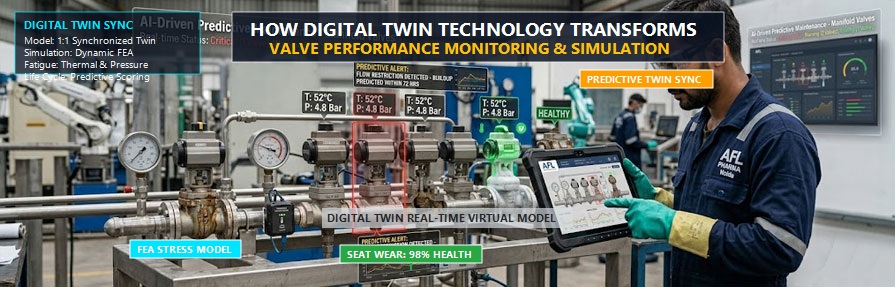
Industrial valves have traditionally been monitored through periodic inspections, manual readings, and reactive maintenance practices. While effective in the past, these methods struggle to keep pace with modern process demands where uptime, safety, and efficiency are increasingly data-driven. This gap has accelerated the adoption of digital twin technology—a virtual representation of physical assets that mirrors real-world behaviour in real time.
In fluid control and instrumentation systems, digital twins are reshaping how valve performance is monitored, analyzed, and optimized. Instead of relying solely on historical data or manual checks, engineers can now observe valve behaviour continuously, predict failures before they occur, and simulate operating scenarios without interrupting live systems.
This shift marks a fundamental change from condition observation to performance intelligence.
What Is a Digital Twin in the Context of Valves?
A digital twin is a dynamic, data-driven virtual model of a physical valve that continuously updates based on real operating conditions. Unlike static simulations, a digital twin evolves as the valve operates, reflecting changes in pressure, temperature, cycle frequency, and performance trends.
For valves, a digital twin typically represents:
- Mechanical behaviour under operating pressure
- Opening and closing cycles over time
- Response to temperature and flow variations
- Degradation patterns caused by wear or corrosion
- The digital twin does not replace the physical valve—it augments understanding by making invisible performance data visible and actionable.
Why Traditional Valve Monitoring Has Limitations
Conventional valve monitoring relies on indirect indicators such as leaks, pressure drops, or abnormal readings. These signs often appear after performance has already degraded, leaving little room for proactive intervention.
Key limitations include:
- Infrequent inspection intervals
- Lack of real-time visibility
- Dependence on operator experience
- Difficulty correlating valve behavior with process conditions
- As systems become more complex and operate closer to design limits, these limitations increase operational risk.
| Lifecycle Stage | Physical Valve Asset | Digital Twin Simulation Model | Operational Outcome |
|---|---|---|---|
| Commissioning | Installed on process line with static test | Finite element CFD flow & stress profile | Validates sizing margin against surge pressure |
| Daily Operations | Subject to thermal cycling & pressure drops | Real-time thermal-mechanical fatigue mapping | Calculates accumulated stem strain in real time |
| Predictive Maintenance | Routine 2-year calendar overhaul | Remaining Useful Life (RUL) algorithm | Extends MTBF by scheduling overhauls only on wear |
| Root Cause Analysis | Post-failure metallurgical inspection | Historical multi-variant telemetry playback | Pinpoints exact cavitation or surge trigger |
How Digital Twins Change Valve Performance Visibility
Digital twin technology addresses these limitations by providing continuous insight into valve behavior. By combining sensor data, operating history, and analytical models, digital twins allow engineers to understand not just what is happening, but why it is happening.
Enhanced visibility includes:
- Real-time tracking of valve position and response
- Detection of abnormal operating patterns
- Identification of gradual performance drift
- Correlation between valve behavior and process conditions
- This level of insight transforms valves from passive components into actively monitored assets.
- From Reactive Maintenance to Predictive Intelligence
One of the most impactful benefits of digital twins is their role in predictive maintenance. Rather than waiting for failure indicators, digital twins analyze trends and deviations to forecast when performance will decline beyond acceptable limits.
Predictive intelligence enables:
- Early identification of wear or seal degradation
- Maintenance scheduling based on actual condition
- Reduced unplanned downtime
- Improved spare parts planning
- By shifting maintenance from time-based to condition-based, digital twins help optimize both reliability and cost.
- Simulation Without Risk: Testing Scenarios Virtually
Digital twins allow engineers to simulate operating scenarios that would be impractical or risky to test on live systems. This capability is particularly valuable in high-pressure or safety-critical valve applications.
Simulation benefits include:
- Evaluating valve response under extreme conditions
- Assessing the impact of process changes
- Validating control strategies before implementation
- Training personnel using realistic virtual models
- This ability to test “what-if” scenarios improves decision-making while reducing operational risk.
- Data Integration and the Role of Analytics
- Digital twins rely on accurate data streams and analytical models to deliver value. Valve performance data is integrated with process parameters to create a holistic view of system behaviour.
Key analytical capabilities include:
- Trend analysis across operating cycles
- Pattern recognition for early anomaly detection
How Digital Twin Architecture Works for Valve Performance Monitoring
Digital twin technology for valves is built on a layered architecture that connects physical valve behaviour with analytical intelligence. Rather than being a single software tool, a digital twin is an ecosystem that combines sensing, modeling, and analytics.
A typical digital twin architecture for valves includes:
- Physical layer: the valve operating under real process conditions
- Sensing layer: pressure, temperature, position, or cycle-count data
- Data layer: real-time data aggregation and historical storage
- Model layer: physics-based and data-driven performance models
- Insight layer: analytics, alerts, and predictive outputs
- Together, these layers create a living representation of valve performance that evolves continuously.
Role of Instrumentation Valves in Digital Twin Systems
Instrumentation valves—particularly manifold valves—play a critical role in digital twin implementations because they directly interface with pressure measurement and control loops.
In digital twin environments, manifold valves:
- Provide stable reference points for pressure data
- Enable accurate modeling of isolation and venting behaviour
- Support repeatable calibration and validation
- Act as boundary elements between process and instrumentation
- Because of this positioning, manifold valves often become the anchor assets around which digital twin models for fluid systems are built.
Applying Digital Twins Across Manifold Valve Configurations
Digital twin value scales with manifold valve complexity and application criticality.
As configuration complexity increases, digital twins offer deeper insight into performance and risk.
Digital Twin Use Cases in Industrial Valve Monitoring
Digital twin technology enables multiple high-value use cases across industries:
- Condition monitoring: Continuous tracking of pressure response, valve movement, and operating cycles reveals early signs of wear or abnormal behaviour.
- Leak detection: Subtle pressure decay patterns can be identified long before visible leakage occurs.
- Performance benchmarking: Actual valve behaviour is compared against expected design performance, highlighting deviation trends.
- Lifecycle optimization: Maintenance intervals are optimized based on real usage rather than fixed schedules.
- These use cases move valve monitoring from reactive troubleshooting to proactive optimization.
Integration with Automation and Control Systems
Digital twins do not replace control systems—they enhance them. Valve digital twins integrate with existing automation architectures to provide context and intelligence.
Typical integrations include:
- Data exchange with PLCs or DCS platforms
- Visualization through SCADA or asset management systems
- Alarm logic refinement using predictive insights
- Feedback loops for control optimization
- This integration ensures digital twin insights are actionable within existing operational workflows.
Digital Twins and High-Pressure / Safety-Critical Valves
In high-pressure and safety-critical environments, digital twins offer significant risk-reduction benefits.
For these applications, digital twins:
- Monitor stress-related performance indicators
- Detect abnormal response under pressure cycling
- Support safer maintenance planning
- Reduce reliance on intrusive inspections
- By providing early warning signals, digital twins help prevent failures that could have serious safety or environmental consequences.
- Transitioning from Pilot to Plant-Wide Adoption
- Most digital twin programs begin with pilot implementations on critical valves before expanding plant-wide.
Successful transition strategies include:
- Starting with high-impact measurement points
- Validating model accuracy over time
- Training teams to interpret insights correctly
- Gradually integrating insights into maintenance planning
- This phased approach ensures digital twins deliver measurable value before large-scale deployment.
- Using a Structured Valve Portfolio to Support Digital Twin Modeling
- Consistency in valve design and specification simplifies digital twin modeling and improves accuracy.
Preparing for the Next Stage of Valve Intelligence
Digital twins represent a shift toward intelligent asset management. As analytics and connectivity improve, valve digital twins will become more predictive, more autonomous, and more integrated into plant-wide optimization strategies.
In the next section, these developments will be translated into buyer guidance, adoption checklists, FAQs, and implementation considerations, helping organizations move confidently toward digital twin-enabled valve monitoring.:
How to Prepare Your Organization for Digital Twin–Based Valve Monitoring
Successful adoption of digital twin technology for valve performance monitoring requires more than software deployment. It involves aligning engineering, maintenance, and operations teams around a shared understanding of how data will be used to improve reliability and safety.
Before implementation, organizations should evaluate:
- Which valves are most critical to safety, uptime, or compliance
- Where unplanned downtime has historically occurred
- How valve data will be consumed by engineering and maintenance teams
- Whether existing automation infrastructure can support real-time data integration
- Starting with a focused scope ensures that digital twin initiatives deliver measurable value early in the adoption cycle.
Buyer Checklist – Is Your Plant Ready for Valve Digital Twins?
Use the checklist below to assess readiness for implementing digital twin technology in valve performance monitoring.:
Reviewing Valve Platforms That Support Digital Twin Integration
Digital twin initiatives are most effective when built on consistent, well-documented valve platforms.
Configuration references:
Summary – From Valve Monitoring to Performance Intelligence
Digital twin technology transforms valve performance monitoring from periodic observation into continuous intelligence. By combining real-time data, analytics, and simulation, digital twins enable safer operation, predictive maintenance, and informed decision-making.
As digital transformation accelerates across process industries, valve digital twins will become an essential component of intelligent asset management strategies.
Frequently Asked Questions (Voice-Search Optimized)
It is a virtual, data-driven model that mirrors real valve behaviour in real time.
No. They complement inspections by enabling predictive and condition-based monitoring.
Yes. They are especially valuable in high-pressure and safety-critical applications.
Accuracy improves over time as models learn from real operating data.
Most plants begin with limited pilots and expand gradually as experience grows.
Yes. They enable maintenance to be scheduled based on actual valve condition.