
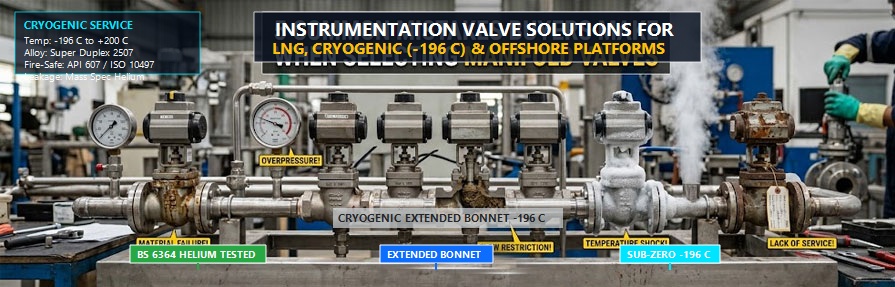
Liquefied natural gas (LNG) terminals, cryogenic processing plants, and offshore platforms operate under some of the harshest conditions in the industrial world. Extremely low temperatures, high operating pressures, corrosive marine environments, and continuous operation place extraordinary demands on every component in the system – especially instrumentation valves.
In LNG and cryogenic service, temperatures can drop below –160°C. At these conditions, standard valve materials lose ductility, seals become brittle, and improper design can lead to leakage or catastrophic failure. Offshore platforms introduce additional challenges such as saltwater corrosion, vibration, limited maintenance access, and strict safety regulations.
Instrumentation valves installed in these environments are not ordinary shut-off devices. They are responsible for:
- • Isolating process pressure• Protecting sensitive instruments• Enabling safe calibration• Supporting emergency shutdown procedures
A single valve failure can:
- • Shut down production• Trigger safety alarms• Cause environmental risk• Lead to massive financial loss
- For this reason, LNG and offshore projects demand purpose-engineered instrumentation valve solutions – not standard industrial valves.
However, many failures still occur because:
- • Wrong material selection• Inadequate low-temperature testing• Improper sealing design• Non-compliance with offshore standards
- These issues are often discovered only after commissioning, when replacement becomes extremely costly.
Understanding how instrumentation valves must be designed, selected, and applied in LNG, cryogenic, and offshore platforms is critical for engineers, EPC contractors, and procurement teams responsible for project reliability.
What Are Instrumentation Valves in LNG & Offshore Systems?
Instrumentation valves are precision-engineered valves used to control, isolate, and protect measuring instruments such as pressure gauges, transmitters, flow meters, and analyzers. In LNG and offshore applications, they serve as the interface between high-pressure process lines and sensitive instrumentation.
Unlike process valves, instrumentation valves are designed for:
- • Fine control• Zero leakage• Repeated operation• Accurate isolation
In cryogenic and offshore service, these valves must also withstand:
- • Extreme cold• Rapid temperature cycling• High pressure• Corrosive salt atmosphere
- Their performance directly affects measurement accuracy and plant safety.
Why Valve Selection Is Critical in Cryogenic & Offshore Environments
Valve selection in LNG and offshore facilities is not just a design decision – it is a safety decision.
Improper valve selection can result in:
- • Seal failure at low temperature• Stem seizure due to ice formation• Leakage under pressure• Material embrittlement• Inability to operate during emergencies
In offshore environments, failure consequences are even higher due to:
- • Limited evacuation routes• Fire and explosion risks• Environmental regulations
This is why projects follow strict standards such as:
- • API• ASME• ISO• NORSOK
Every valve must be:
- ✔ Cryogenically tested✔ Fire-safe certified✔ Corrosion resistant✔ Traceable
Operating Challenges in LNG, Cryogenic & Offshore Systems
Cryogenic challenges
- Extreme low temperatures
- Thermal contraction
- Seal shrinkage
- Ice formation
- Metal embrittlement
Offshore challenges
- Saltwater corrosion
- Continuous vibration
- Limited maintenance access
- Harsh weather
- Explosion risk
These conditions require:
- • Special materials• Extended bonnets• Metal-to-metal sealing• Anti-freeze stem design
- Role of Instrumentation Valves in Safety & Operations
Instrumentation valves are critical for:
- • Emergency isolation• Blowdown procedures• Safe calibration• Instrument replacement• Leak containment
Without proper valve design:
- • Maintenance becomes dangerous• Plant uptime reduces• Risk increases
- Foundation for Reliable Valve Selection
Selecting the right instrumentation valve depends on:
- • Temperature range• Pressure rating• Process media• Installation location• Certification requirements
- This foundation helps engineers determine which valve design and material are suitable for LNG and offshore service.
How Instrumentation Valves Are Engineered for LNG, Cryogenic & Offshore Service
Instrumentation valves used in LNG, cryogenic, and offshore applications are not standard industrial valves. They are purpose-engineered to operate reliably under extreme temperature, pressure, and environmental conditions.
For cryogenic service, valves are designed with:
- Extended bonnet construction to protect stem packing from extreme cold
- Special low-temperature alloys that maintain ductility
- PTFE or metal-to-metal sealing systems
- Cryogenic testing at temperatures below –196°C
In offshore environments, valves incorporate:
- • Corrosion-resistant materials (SS316, Duplex, Super Duplex)• Anti-vibration stem design• Fire-safe construction• Anti-blowout stem safety
- These design features ensure that valves continue to operate safely even during temperature shock, pressure surges, and emergency situations.
Industry Applications – Where These Valves Are Used
Instrumentation valve solutions are widely deployed across LNG terminals, cryogenic plants, and offshore platforms.
In LNG facilities, they are used for:
- • Storage tank instrumentation• Boil-off gas monitoring• Transfer line pressure measurement• Safety shutdown systems
In cryogenic processing plants, they support:
- • Liquid nitrogen systems• Liquid oxygen instrumentation• Cold box measurement loops
In offshore platforms, valves are used in:
- • Wellhead instrumentation• Separator pressure monitoring• Gas compression systems• Flare and vent systems
Technical Parameters That Matter in Extreme Conditions
Selecting instrumentation valves for LNG and offshore service requires detailed evaluation of technical parameters.
Key factors include:
- • Minimum design temperature (MDT)• Pressure rating• Material impact strength• Stem sealing design• Fire-safe certification• Compliance with NACE for sour service
Incorrect selection can lead to:
- • Seal cracking• Leakage• Valve seizure• System shutdown
Practical Offshore Case Example
An offshore gas platform experienced leakage in pressure instrument isolation valves during winter operation. Investigation revealed:
- • Standard stainless steel valves used• No cryogenic testing• Packing failure due to temperature shock
- The platform upgraded to cryogenic-rated instrumentation valves.
After upgrade:
- • Zero leakage• Stable operation• Reduced maintenance visits• Improved safety compliance
Standard Valves vs Cryogenic-Rated Valves – Comparison
| Engineering Parameter | Standard Industrial Valve | Cryogenic-Rated Valve (LNG Service) |
|---|---|---|
| Temperature Rating | Ambient service (–29°C / –20°F minimum limit) | Cryogenic certified down to –196°C (–320°F in LN2) |
| Bonnet Architecture | Standard compact bonnet | Extended vapor column (BS 6364 compliant gas buffer) |
| Seal & Stem Packing | Standard virgin PTFE (brittle below –50°C) | Cryogenic PCTFE / Kel-F & live-loaded Grafoil |
| Testing & Quality Protocol | Ambient hydrostatic pressure test only | Cryostat helium leak testing at –196°C |
| Offshore Marine Suitability | Limited (risk of stem seizure and seal blowout) | Fully certified for harsh marine & topside LNG service |
| Safety & Design Compliance | Basic commercial valve standard | API 6D, BS 6364, ISO 28921-1, NACE MR0175 / ISO 15156 |
Why Choose Pioneer for LNG & Offshore Instrumentation Valves
Pioneer provides instrumentation valve solutions specifically designed for:
- • LNG terminals• Cryogenic processing plants• Offshore platforms
Key advantages:
- • Cryogenic-tested valves• Fire-safe certification• Marine-grade materials• Full traceability• EPC project support
Procurement and Project Integration Considerations
In LNG terminals, cryogenic plants, and offshore platforms, instrumentation valves are not procured as standalone items. They are part of EPC project packages that include transmitters, impulse tubing, manifolds, and control systems. Because of this, procurement decisions must focus on long-term reliability and compliance, not just unit price.
Key procurement considerations include:
- Compliance with project specifications
- Cryogenic and fire-safe certification
- Material traceability (MTC, PMI)
- NACE compliance for sour service
- Availability of spares
- OEM technical support
Standardizing approved valve models across projects helps reduce:
- • Engineering rework• Maintenance complexity• Risk of non-compliance
Buyer Checklist – Selecting Instrumentation Valves for LNG & Offshore
Before finalizing instrumentation valves, engineers and buyers should follow a structured evaluation process.
Selection checklist:
Summary – Reliability in Extreme Environments
LNG, cryogenic, and offshore operations demand zero compromise on safety and reliability. Instrumentation valves act as the first line of defense between extreme process conditions and sensitive instruments.
Properly selected valves provide:
- • Leak-free operation• Safe isolation• Long service life• Compliance with international standards
- In extreme environments, valve selection is not a purchase decision.It is a risk management decision.
Here is the complete metadata pack for:
- Instrumentation Valve Solutions for LNG, Cryogenic & Offshore Platforms
Frequently Asked Questions (Voice-Search Optimized)
Because standard valves fail at extremely low temperatures below –160°C.
SS316, Duplex, and nickel alloys are commonly used.
Yes, they are tested to API fire-safe standards.
Yes, they are designed for marine environments.
Yes, periodic inspection of seals and stem packing is recommended.
Yes, LNG and offshore projects require full documentation.