
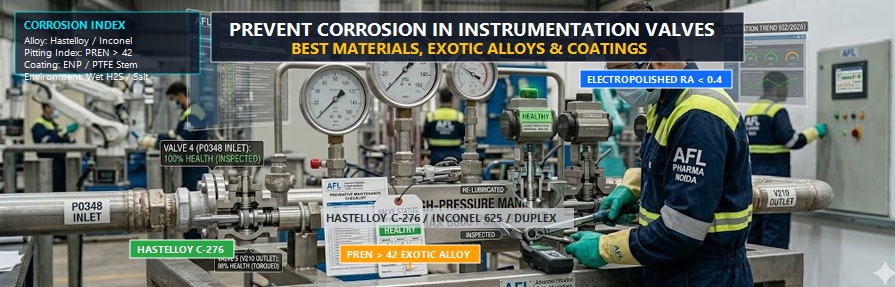
Corrosion is one of the most destructive and costly problems in industrial instrumentation systems. From offshore platforms and refineries to chemical plants and water treatment facilities, instrumentation valves are continuously exposed to aggressive environments that accelerate material degradation.
In real plant conditions, corrosion does not appear overnight. It develops slowly due to:
- • Moisture ingress• Chemical exposure• Salt-laden air• High temperature• Acidic or alkaline media
By the time leakage becomes visible, internal damage has already progressed. This leads to:
- • Seal failure• Stem seizure• Loss of pressure integrity• Unsafe maintenance conditions• Unplanned shutdowns
In many plants, corrosion-related failures are treated as unavoidable. This mindset is incorrect. Most corrosion failures can be prevented through correct material selection, surface treatment, and protective coatings.
Instrumentation valves act as the first barrier between aggressive process media and sensitive instruments. When corrosion attacks these valves:
- • Calibration accuracy drops• Maintenance frequency increases• Spare consumption rises• Safety risk multiplies
- Engineers responsible for plant reliability must understand that corrosion prevention is not a coating decision alone. It is a design and material engineering decision.
Understanding how to prevent corrosion in instrumentation valves is essential for:
- • Instrumentation engineers• Maintenance managers• EPC project teams• Procurement professionals• Offshore & chemical plant operators
- This guide explains the root causes of corrosion, material selection strategies, and coating technologies used to extend valve life in harsh industrial environments.
What Is Corrosion in Instrumentation Valves?
Corrosion in instrumentation valves refers to the gradual deterioration of metal surfaces due to chemical or electrochemical reactions with the surrounding environment.
In industrial service, this occurs due to:
- • Contact with corrosive fluids• Exposure to humidity and salt air• Temperature cycling• Contaminants in process media
Corrosion can attack:
- • Valve body• Stem• Seats• Threads• Internal passages
- Once corrosion starts, it reduces material thickness, weakens sealing surfaces, and compromises pressure containment.
Why Corrosion Control Is Critical in Instrumentation Systems
Instrumentation valves are precision components. Even minor surface damage affects:
- • Sealing integrity• Smooth operation• Measurement accuracy
Corrosion leads to:
- • Stem jamming• Packing leakage• Thread damage• Internal blockage
In industries such as:
- • Oil & gas• Offshore• Chemical processing• Power generation• Water treatment
corrosion failures can trigger:
- • Environmental incidents• Production loss• Safety shutdowns• Compliance violations
- Preventing corrosion is therefore part of process risk management, not just maintenance.
Common Corrosion Problems Observed in Plants
Field inspections commonly reveal:
- • Pitting corrosion on valve bodies• Rust formation on stems• Thread seizure• Crevice corrosion under packing• Galvanic corrosion between dissimilar metals
- Real plant situation
An offshore platform experienced frequent valve seizure. Investigation showed:
- • Carbon steel valves used• No protective coating• Continuous salt spray exposure
Result:
- • Severe rust• Inoperable valves• Emergency replacement
- This failure was caused by wrong material selection, not operational error.
- Role of Materials & Coatings in Corrosion Prevention
Materials and coatings form the primary defense against corrosion. Proper selection ensures:
- • Resistance to chemicals• Protection against moisture• Long-term surface integrity
Without them:
- • Even high-grade valves fail early• Maintenance cost increases• Safety risk rises
- Foundation for Corrosion Prevention Strategy
Effective corrosion prevention depends on:
- • Understanding process media• Operating temperature• Environmental exposure• Material compatibility• Coating technology
- This foundation allows engineers to select the right base material and protective coating for each application.
Selecting Corrosion-Resistant Materials for Instrumentation Valves
Material selection is the first and most important step in corrosion prevention. Using the wrong base metal makes even the best coating ineffective.
Common corrosion-resistant materials
- Stainless Steel 316 / 316L
- Good resistance to moisture
- Suitable for chemical plants
- Used in water & oil service
- Duplex Stainless Steel
- High chloride resistance
- Offshore & marine use
- Higher strength than SS316
- Monel & Nickel Alloys
- Excellent for acidic service
- LNG & offshore gas systems
- High temperature resistance
- Hastelloy
- Extreme chemical resistance
- Acidic & aggressive media
Wrong material selection results in:
- • Pitting corrosion• Stress cracking• Premature valve failure
Protective Coatings Used in Industrial Valves
When material upgrade is not feasible, coatings act as the second line of defense.
Common coating types
- PTFE Coating
- Chemical resistance
- Low friction
- Smooth operation
- Epoxy Coating
- Moisture protection
- External corrosion control
- Offshore structures
- Nickel Plating
- Hard surface
- Wear resistance
- Improved durability
- Xylan / Fluoropolymer Coating
- Anti-stick
- Corrosion protection
- High temperature resistance
Correct coating selection depends on:
- • Process fluid• Temperature• External environment
Internal vs External Corrosion Protection
- Internal corrosion
- Process media attack
- Acidic fluids
- Contaminants
- Protection methods:
- Correct base material
- Internal coating
- Proper flushing
- External corrosion
- Salt spray
- Humidity
- Chemical fumes
- Protection methods:
- Epoxy painting
- Zinc coating
- Protective covers
Practical Industry Example
A coastal refinery experienced severe valve corrosion within 8 months.
- Findings:
- Carbon steel valves
- No coating
- High humidity
- Solution:
- Switched to SS316
- Epoxy external coating
- Regular inspection
- Results:
- No corrosion after 2 years
- Reduced maintenance
- Improved safety
Carbon Steel vs Stainless Steel – Corrosion Comparison
| Corrosion Parameter | Carbon Steel Valve | AISI 316 / 316L Stainless Steel |
|---|---|---|
| Moisture & Rain Resistance | Poor (rapid surface oxidation and rust) | Excellent self-healing chromium oxide passive film |
| Marine Salt Environment | Severe rust, pitting attack, and stem seizure | Highly resistant to coastal atmospheric corrosion |
| Required Maintenance Frequency | High (frequent painting, coating, and seal checks) | Low (extended inspection intervals) |
| Service Life Expectancy | Short (1 to 3 years in aggressive atmospheres) | Long (10+ years maintenance-free operation) |
Why Choose Pioneer for Corrosion-Resistant Valves
Pioneer supplies instrumentation valves designed for:
- • Offshore• Chemical plants• Marine environments• High humidity zones
- Key advantages: • Material traceability• NACE compliance• Special coatings• Project support
Procurement and Project Specification Considerations
In corrosion-prone environments, instrumentation valves must be specified correctly at the project design stage. Once installed, replacing wrong material valves becomes costly and risky.
Procurement teams should evaluate:
- Process fluid chemistry
- Chloride content
- Ambient environment (marine / industrial)
- Temperature range
- Compliance with NACE / ISO standards
- Availability of material test certificates (MTC)
Standardizing corrosion-resistant materials across similar loops:
- • Reduces spare part complexity• Prevents wrong installation• Improves long-term reliability
Buyer Checklist – Preventing Corrosion in Instrumentation Valves
Before finalizing valve specification, use this checklist:
Summary – Corrosion Prevention Is Engineering, Not Guesswork
Corrosion in instrumentation valves is not inevitable.It is the result of:
- • Wrong material choice• Poor coating selection• Lack of inspection
By applying proper material engineering and protective coatings, industries can achieve:
- ✔ Longer valve life✔ Safer operation✔ Reduced maintenance✔ Stable measurements
- In harsh environments, corrosion prevention is not a maintenance task.It is a design responsibility.
Frequently Asked Questions (Voice-Search Optimized)
Duplex stainless steel and nickel alloys offer excellent resistance.
No, coatings only support protection. Base material matters most.
It helps externally but internal material must also be corrosion-resistant.
At least every 6 months in harsh environments.
Yes, especially for sour gas applications.
Yes, internal corrosion disturbs pressure transmission.