
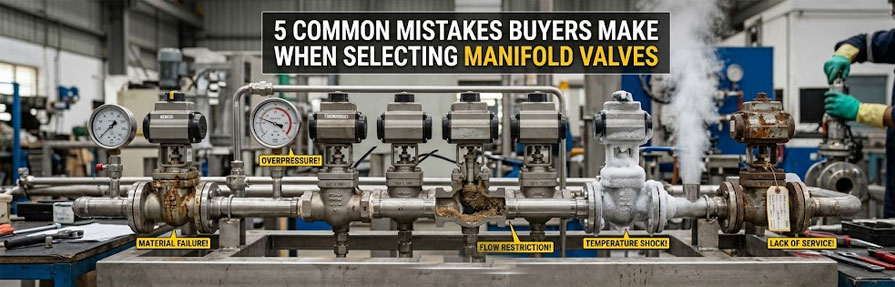
In industrial instrumentation systems, manifold valves are often treated as secondary components—selected late in the design or procurement cycle after major equipment decisions are made. This approach frequently leads to mismatches between the manifold valve, the instrumentation, and the actual process conditions. Over time, these mismatches can result in inaccurate measurements, unsafe maintenance procedures, premature valve failure, or costly rework.
For buyers in oil & gas, chemical, power, and process industries, selecting the right manifold valve is not simply a matter of choosing a 2-way, 3-way, or 5-way configuration. It requires a clear understanding of application requirements, system behaviour, and long-term operational realities. Many common selection mistakes arise not from lack of options, but from incomplete evaluation at the buying stage.
This guide highlights the most frequent mistakes buyers make when selecting manifold valves—and why avoiding them early can significantly improve safety, reliability, and lifecycle performance.
Why Manifold Valve Selection Errors Are So Common
Manifold valves sit at the intersection of process piping and instrumentation. Because they are relatively compact and standardized, buyers often assume they are interchangeable across applications. In reality, manifold valves are highly application-dependent components whose performance is closely tied to pressure conditions, measurement type, and maintenance practices.
Selection errors commonly occur because:
- Manifold valves are treated as accessories rather than safety-critical components
- Procurement decisions are driven by configuration names instead of application needs
- System behaviour (pressure dynamics, calibration frequency) is not fully considered
- Standardization is applied without understanding where variation is required
These issues are especially common in multi-project or multi-plant organizations where procurement teams aim to simplify sourcing without fully accounting for technical differences.
The Impact of Incorrect Manifold Valve Selection
When a manifold valve is incorrectly selected, the consequences may not be immediate. In many cases, the system will operate initially but develop issues over time. These issues often surface during calibration, maintenance, or abnormal operating conditions.
Typical impacts include:
- Difficulty isolating instruments safely
- Inaccurate or unstable pressure readings
- Increased risk during maintenance activities
- Higher maintenance frequency and downtime
- Reduced instrument lifespan
Because manifold valves directly affect how pressure is handled at the instrumentation level, even minor selection errors can have outsized operational effects.
Why Buyers Need an Application-First Mindset
One of the most common underlying causes of selection mistakes is the absence of an application-first mindset. Buyers often focus on valve configuration or price before clearly defining how the valve will be used within the system.
An application-first approach requires buyers to understand:
- Whether the valve is supporting pressure or differential pressure measurement
- How often the instrument will be calibrated or serviced
- Whether pressure equalization is required
- The level of safety required during maintenance
- The operating pressure and temperature range
Without this clarity, even technically correct valves can be poorly matched to real operating conditions.
How Standardization Can Create Hidden Risks
Standardization is widely used in industrial procurement to reduce complexity and cost. While standardization can be beneficial, it becomes risky when applied without technical context. Using the same manifold valve configuration across all applications may simplify purchasing, but it can introduce performance or safety issues in systems with different measurement or maintenance needs.
For example:
- A standardized 2-way manifold valve may be insufficient for systems requiring pressure equalization
- A standardized configuration may increase maintenance risk in safety-critical areas
- Over-standardization can force technicians to use workarounds during calibration
Understanding where standardization is appropriate—and where it is not—is critical for effective manifold valve selection.
The Importance of Long-Term Operational Perspective
Another common mistake is selecting manifold valves based solely on initial installation requirements. In practice, manifold valves are operated most frequently during maintenance, calibration, and troubleshooting—not during normal process operation.
Buyers should consider:
- How easily the valve can be operated in confined spaces
- Whether venting can be performed safely and predictably
- How the valve supports repeatable calibration procedures
- Whether the configuration aligns with maintenance team practices
A valve that looks suitable on paper may become problematic when viewed from a maintenance or safety perspective.
Setting the Stage for Identifying the Most Common Mistakes
The majority of manifold valve selection errors fall into a small number of repeatable patterns. These mistakes are not limited to inexperienced buyers—they also occur in large, technically capable organizations when communication gaps exist between engineering, procurement, and maintenance teams.
By identifying and understanding these common mistakes, buyers can:
- Reduce safety and compliance risks
- Improve instrumentation reliability
- Minimize lifecycle costs
- Make more confident, application-aligned purchasing decisions
In the next section, these mistakes will be clearly identified and explained to show where buyers most often go wrong—and how those errors can be avoided.
Selecting Manifold Valves by Configuration Name Only
One of the most common mistakes buyers make is selecting manifold valves purely by configuration labels such as 2-way, 3-way, or 5-way, without fully understanding what those configurations actually do in the system.
While configuration names describe valve count and basic function, they do not explain:
- The type of measurement being performed
- Whether pressure equalization is required
- How maintenance will be carried out
- The level of safety needed during servicing
For example, selecting a 2-way manifold valve simply because it is “standard” can be problematic in differential pressure systems where equalization is essential. Configuration should always follow application logic, not naming conventions.
Ignoring the Measurement Type (Pressure vs Differential Pressure)
Another frequent error is failing to distinguish between pressure measurement and differential pressure measurement during valve selection. These two measurement types place very different demands on manifold valves.
In pressure measurement systems, isolation and venting may be sufficient. In differential pressure systems, however, pressure equalization between high and low sides is critical to prevent sensor damage and inaccurate readings.
Buyers who overlook this distinction often experience:
- Calibration difficulties
- Unstable or drifting measurements
- Increased instrument wear
Correct selection requires aligning the manifold valve configuration with the measurement principle, not just the process connection.
Underestimating Maintenance and Calibration Requirements
Manifold valves are operated most frequently during maintenance and calibration, not during normal process operation. Buyers often focus on installation requirements while overlooking how the valve will be used over its lifecycle.
Common oversights include:
- Limited access for valve operation
- Inadequate venting control during calibration
- Unsafe pressure release procedures
- Increased reliance on workarounds by technicians
A manifold valve that is difficult to operate or vent safely can slow maintenance activities and increase risk. Selection should always account for how often the valve will be used and by whom.
Over-Standardization Across Different Applications
Standardization is a common procurement strategy, but when applied indiscriminately, it becomes a source of error. Using the same manifold valve configuration across all applications may simplify purchasing, but it can create hidden technical and safety issues.
Examples of over-standardization problems include:
- Using basic configurations in safety-critical measurement points
- Applying the same valve type to both pressure and differential pressure systems
- Ignoring differences in operating pressure, temperature, or media
Effective standardization requires application grouping, where similar systems share valve types, while critical or unique applications are treated separately.
Treating Manifold Valves as Low-Criticality Components
Many buyers underestimate the importance of manifold valves because of their size and cost relative to major equipment. This leads to minimal technical review during procurement and limited involvement of instrumentation or maintenance teams.
In reality, manifold valves directly affect:
- Instrument accuracy
- Maintenance safety
- System downtime
- Compliance with plant procedures
Treating manifold valves as low-criticality items often results in higher lifecycle costs and increased operational risk. Proper evaluation at the buying stage prevents these issues.
How the Right Product Range Helps Avoid These Mistakes
Avoiding the above mistakes requires access to a clear, application-focused manifold valve range that supports different measurement and safety needs.
Reviewing a structured manifold valve category helps buyers match configurations to real applications rather than forcing one-size-fits-all solutions:
👉 https://pioneerfitting.com/manifold-valves/
Configuration-specific references:
- 2-way manifold valves (basic isolation)
👉 https://pioneerfitting.com/2-way-manifolds-valves/ - 3-way manifold valves (pressure equalization)
👉 https://pioneerfitting.com/3-way-manifolds-valves/ - 5-way manifold valves (full isolation and venting)
👉 https://pioneerfitting.com/5-way-manifolds-valves/
For broader system alignment and consistent sourcing, buyers may also review the complete instrumentation offering:
👉 https://pioneerfitting.com/product-range/
How Buyers Can Prevent Manifold Valve Selection Errors
Avoiding manifold valve selection mistakes requires a shift from configuration-driven buying to application-driven evaluation. Buyers who consistently select the correct manifold valves tend to follow a structured process that involves engineering, instrumentation, and maintenance teams early in the decision cycle.
Rather than asking “Which valve is cheapest or standard?”, effective buyers ask:
- What measurement is being performed?
- How critical is this measurement to safety or operation?
- How often will calibration or maintenance occur?
- What level of isolation and venting is required?
This mindset ensures that manifold valves are treated as functional safety components, not commodity items.
Buyer Correction Checklist – Getting Manifold Valve Selection Right
Use the following checklist to correct and prevent the most common selection mistakes:
Pre-selection checklist:
- Clearly define the application (pressure vs differential pressure)
- Identify whether pressure equalization is required
- Assess maintenance frequency and access conditions
- Match configuration to application:
- 2-way → basic isolation
- 3-way → equalization required
- 5-way → safety-critical or high-pressure use
- Confirm pressure, temperature, and media compatibility
- Validate the valve choice with instrumentation or maintenance teams
Following this checklist reduces guesswork and improves long-term system reliability.
Frequently Asked Questions
What is the most common mistake when selecting manifold valves?
The most common mistake is choosing a valve based only on configuration name instead of application requirements.
Are 2-way manifold valves suitable for all pressure measurements?
No. They are suitable only for basic pressure measurement where equalization is not required.
Why is pressure equalization important in manifold valve selection?
Equalization prevents sensor damage and ensures accurate readings in differential pressure systems.
Do manifold valves affect maintenance safety?
Yes. Properly selected manifold valves allow safe isolation and venting during maintenance.
Is standardizing one manifold valve type across all systems a good idea?
Only if applications are similar. Over-standardization can introduce safety and performance risks.
Can incorrect manifold valve selection increase lifecycle cost?
Yes. Poor selection often leads to higher maintenance, downtime, and replacement costs.
Reviewing Manifold Valve Options to Avoid Selection Errors
Access to a structured and application-focused valve range helps buyers avoid the mistakes discussed above.
Manifold valve category overview:
👉 https://pioneerfitting.com/manifold-valves/
Configuration references:
- 2-way manifold valves
👉 https://pioneerfitting.com/2-way-manifolds-valves/ - 3-way manifold valves
👉 https://pioneerfitting.com/3-way-manifolds-valves/ - 5-way manifold valves
👉 https://pioneerfitting.com/5-way-manifolds-valves/
For consistency across projects and systems, buyers may also review the complete instrumentation offering:
👉 https://pioneerfitting.com/product-range/
Summary – Turning Common Mistakes into Better Buying Decisions
Most manifold valve selection mistakes are preventable when buyers move beyond configuration labels and focus on real application needs. By understanding measurement type, maintenance requirements, and safety implications, buyers can select manifold valves that support accurate instrumentation, safer maintenance, and lower lifecycle costs.
A disciplined, application-first approach transforms manifold valve selection from a recurring problem into a reliable, repeatable decision process.