
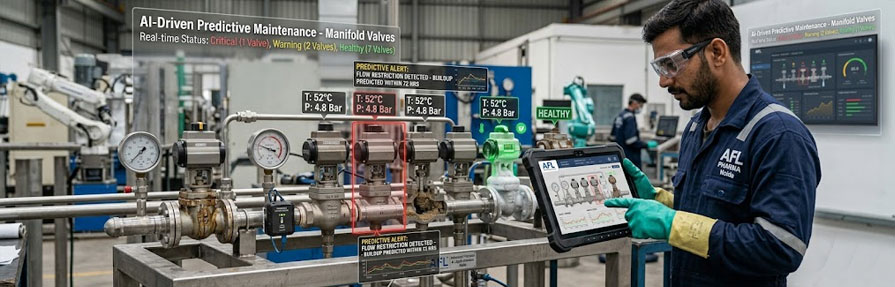
Manifold valves are critical control points in instrumentation systems, responsible for isolating pressure, enabling calibration, and protecting sensitive instruments. Traditionally, maintenance of these valves has relied on fixed schedules, periodic inspections, and reactive interventions after performance issues appear. While this approach has worked for decades, it is increasingly misaligned with modern industrial demands for uptime, safety, and cost efficiency.
AI-driven predictive maintenance represents a fundamental shift in how manifold valve health is monitored and managed. By using data analytics, machine learning, and real-time monitoring, predictive maintenance enables engineers to anticipate failures before they occur—reducing downtime, minimizing risk, and extending asset life.
This guide explains how AI-driven predictive maintenance is transforming manifold valve management, and why it is becoming a cornerstone of modern instrumentation strategies.
Why Traditional Manifold Valve Maintenance Is No Longer Enough
Conventional maintenance strategies are typically time-based. Valves are inspected or replaced according to predefined intervals, regardless of their actual condition. While simple to manage, this approach has inherent limitations.
Key challenges include:
- Inability to detect early-stage degradation
- Unnecessary maintenance on healthy valves
- Unexpected failures between inspection cycles
- High labor and shutdown costs
In high-pressure, safety-critical, or continuous-process environments, these limitations translate directly into operational risk and financial loss.
What Is Predictive Maintenance in Valve Systems?
Predictive maintenance uses operational data to determine when maintenance should be performed—based on actual asset condition rather than elapsed time. In manifold valve systems, this means monitoring indicators that reflect valve health and performance.
Predictive maintenance focuses on:
- Detecting abnormal operating patterns
- Identifying gradual performance drift
- Forecasting remaining useful life
- Scheduling intervention before failure
AI enhances this process by learning from historical and real-time data to recognize patterns that human observation may miss.
How AI Transforms Manifold Valve Monitoring
Artificial intelligence brings advanced analytical capabilities to valve monitoring. Rather than relying on static thresholds, AI models adapt to changing operating conditions and refine predictions over time.
AI-driven systems can:
- Analyze pressure, temperature, and cycle data continuously
- Detect subtle deviations from normal behaviour
- Correlate valve performance with process conditions
- Generate early warnings before failure symptoms are visible
This transforms manifold valves from passive components into actively monitored assets.
Key Data Sources for AI-Based Valve Health Assessment
AI-driven predictive maintenance depends on reliable data streams. For manifold valves, relevant data may include:
- Pressure trends upstream and downstream of the valve
- Temperature exposure over time
- Frequency and speed of valve operation
- Equalization and venting behavior
- Historical maintenance and failure records
By combining multiple data sources, AI models build a comprehensive picture of valve health.
From Threshold Alarms to Intelligent Predictions
Traditional monitoring systems rely on alarm thresholds—alerts triggered when values exceed predefined limits. While useful, thresholds often indicate problems only after damage has begun.
AI-driven predictive maintenance moves beyond thresholds by:
- Identifying abnormal trends rather than single events
- Recognizing patterns associated with early wear
- Adapting predictions as operating conditions change
- Reducing false alarms caused by normal process variation
This shift improves both reliability and operator confidence.
Why Manifold Valves Are Ideal Candidates for Predictive Maintenance
Manifold valves are particularly well suited to predictive maintenance because of their role and operating characteristics.
Reasons include:
- Frequent interaction during calibration and maintenance
- Direct exposure to pressure and process conditions
- Clear functional states (isolation, equalization, venting)
- High impact of failure on measurement accuracy and safety
Monitoring these valves proactively delivers outsized benefits compared to many other components.
Impact on Safety, Reliability, and Lifecycle Cost
AI-driven predictive maintenance improves multiple dimensions of valve management simultaneously.
Benefits include:
- Reduced likelihood of sudden leaks or failures
- Improved safety by minimizing emergency interventions
- Extended service life through optimized maintenance timing
- Lower total cost of ownership
In regulated industries, improved reliability also supports compliance and audit readiness.
Organizational Shift Required for Predictive Maintenance
Adopting AI-driven predictive maintenance is not just a technical change—it requires an organizational mindset shift. Teams must move from reactive response to data-driven planning.
Key changes include:
- Trusting data-driven insights alongside experience
- Integrating analytics into maintenance workflows
- Training teams to interpret predictive alerts
- Aligning engineering, maintenance, and operations objectives
This cultural shift is essential for realizing the full value of AI-driven maintenance.
Setting the Foundation for AI-Driven Maintenance Adoption
Understanding how AI-driven predictive maintenance works is the first step toward adoption. The technology builds on existing instrumentation and automation infrastructure, enhancing it with intelligence rather than replacing it.
In the next section, these concepts will be translated into practical system architectures, real-world use cases, and implementation strategies for AI-driven predictive maintenance of manifold valves.
How AI-Driven Predictive Maintenance Systems Work for Manifold Valves
AI-driven predictive maintenance for manifold valves is built on a layered architecture that connects physical valve behaviour with intelligent analytics. Rather than replacing existing instrumentation systems, AI enhances them by extracting insights from operational data.
A typical architecture includes:
- Physical layer: manifold valves operating under live process conditions
- Data acquisition layer: pressure, temperature, and operational signals
- Data processing layer: aggregation, filtering, and normalization
- AI analytics layer: machine learning models for pattern recognition
- Insight layer: predictions, alerts, and maintenance recommendations
This architecture allows continuous learning and adaptation as operating conditions evolve.
Data Inputs That Drive Accurate AI Predictions
AI models depend on quality data to generate reliable predictions. In manifold valve applications, the most valuable inputs reflect how the valve behaves over time rather than isolated readings.
Key data inputs include:
- Pressure variation during isolation and equalization
- Frequency of valve operation and cycling patterns
- Temperature exposure across operating periods
- Venting response and pressure decay trends
- Historical maintenance and intervention records
By correlating these inputs, AI systems identify early indicators of wear, leakage, or abnormal operation.
Predictive Maintenance Across Manifold Valve Configurations
AI-driven predictive maintenance can be applied across all common manifold valve configurations, with increasing value as complexity and criticality rise.
- 2-valve manifolds
AI focuses on isolation performance, pressure stability, and early leak detection in basic measurement loops.
👉 https://pioneerfitting.com/2-way-manifolds-valves/ - 3-valve manifolds
AI analyzes equalization behavior, pressure balance, and calibration consistency in differential pressure systems.
👉 https://pioneerfitting.com/3-way-manifolds-valves/ - 5-valve manifolds
AI delivers maximum value by monitoring isolation, equalization, and dual venting performance in high-pressure and safety-critical applications.
👉 https://pioneerfitting.com/5-way-manifolds-valves/
As configuration complexity increases, AI insight becomes more granular and actionable.
Machine Learning Models Used in Valve Predictive Maintenance
Different AI models serve different predictive objectives. In manifold valve maintenance, models are typically trained to recognize deviation from normal behavior rather than fixed failure signatures.
Common model types include:
- Anomaly detection models: identify unusual pressure or response patterns
- Trend-based models: track gradual degradation over time
- Classification models: distinguish normal operation from early fault conditions
- Remaining useful life models: estimate time to maintenance requirement
These models improve continuously as they are exposed to more operational data.
Real-World Use Cases in Industrial Environments
AI-driven predictive maintenance delivers tangible value across industries where manifold valves play a critical role.
Leak prediction:
Subtle pressure decay patterns are detected before visible leakage occurs.
Maintenance optimization:
Valves are serviced only when indicators show degradation, reducing unnecessary interventions.
Failure avoidance:
Early alerts prevent sudden isolation or venting failures that could disrupt operations.
Spare parts planning:
Maintenance schedules become predictable, improving inventory management.
These use cases reduce both operational risk and lifecycle cost.
Integration with Automation and Asset Management Systems
AI predictive maintenance systems integrate with existing automation infrastructure to ensure insights lead to action.
Typical integrations include:
- Data exchange with PLC or DCS platforms
- Visualization through asset management dashboards
- Automated alerting and work-order generation
- Feedback loops to refine predictive models
This integration embeds predictive maintenance into daily operational workflows rather than treating it as a separate activity.
Managing False Alarms and Model Trust
One of the early challenges in AI adoption is managing false alarms. Poorly tuned models can generate alerts that reduce operator confidence.
Best practices include:
- Training models on sufficient baseline data
- Gradual rollout with human validation
- Clear thresholds for actionable alerts
- Continuous refinement based on feedback
Trust in AI predictions grows as teams observe consistent accuracy over time.
Using a Structured Manifold Valve Portfolio for AI Deployment
Consistency in valve design and specification simplifies AI modeling and improves predictive accuracy.
Reviewing a structured manifold valve range supports standardized data interpretation:
👉 https://pioneerfitting.com/manifold-valves/
For broader alignment across instrumentation assets and maintenance programs, engineers may also review the complete product offering:
👉 https://pioneerfitting.com/product-range/
Preparing for AI-Enabled Maintenance at Scale
AI-driven predictive maintenance is most effective when implemented progressively. Starting with critical valves allows teams to validate insights, refine models, and build confidence before expanding plant-wide.
In the next section, these principles will be translated into buyer checklists, FAQs, and adoption strategies, enabling organizations to plan and execute AI-driven predictive maintenance for manifold valves with confidence.
How to Prepare Your Plant for AI-Driven Predictive Maintenance
AI-driven predictive maintenance delivers maximum value only when it is implemented with clear objectives and realistic expectations. Rather than attempting full-scale deployment immediately, most plants benefit from a phased approach focused on high-impact instrumentation points.
Before implementation, organizations should assess:
- Which manifold valves are critical to safety, uptime, or compliance
- Historical failure patterns and maintenance pain points
- Availability and quality of operational data
- Integration capability with existing automation and asset management systems
Clear preparation ensures that AI insights translate into actionable maintenance decisions rather than unused data streams.
Buyer Checklist – Is Your Facility Ready for AI Predictive Maintenance?
Use this checklist to evaluate readiness for AI-driven predictive maintenance of manifold valves.
AI readiness checklist:
- Identify critical pressure and differential pressure measurement points
- Confirm data availability (pressure, temperature, valve operation)
- Ensure compatibility with PLC, DCS, or SCADA platforms
- Define maintenance use cases (leak prediction, wear detection, optimization)
- Establish alert thresholds and response procedures
- Train maintenance and operations teams to interpret AI insights
- Start with pilot deployments before plant-wide rollout
Following this checklist reduces implementation risk and accelerates measurable results.
Frequently Asked Questions (Voice-Search Optimized)
What is AI-driven predictive maintenance for manifold valves?
It uses machine learning and analytics to predict valve maintenance needs based on real operating data.
Does AI replace manual inspection completely?
No. AI complements inspections by identifying issues earlier and prioritizing intervention.
Are AI systems reliable for high-pressure valve applications?
Yes, when properly trained and validated, AI systems enhance safety in high-pressure environments.
How long does it take to see value from AI predictive maintenance?
Many plants observe meaningful insights after collecting sufficient baseline data over several months.
Can AI reduce maintenance costs?
Yes. By avoiding unnecessary maintenance and preventing failures, lifecycle costs are reduced.
Is AI predictive maintenance complex to operate?
With proper integration and training, AI systems become part of routine maintenance workflows.
H14: Reviewing Manifold Valve Platforms That Support AI Maintenance
AI-driven predictive maintenance performs best when built on consistent, well-documented valve platforms.
Manifold valve overview:
👉 https://pioneerfitting.com/manifold-valves/
Configuration references:
- 2-valve manifolds
👉 https://pioneerfitting.com/2-way-manifolds-valves/ - 3-valve manifolds
👉 https://pioneerfitting.com/3-way-manifolds-valves/ - 5-valve manifolds
👉 https://pioneerfitting.com/5-way-manifolds-valves/
For system-wide alignment across instrumentation and maintenance programs:
👉 https://pioneerfitting.com/product-range/
Summary – From Scheduled Maintenance to Intelligent Reliability
AI-driven predictive maintenance transforms how manifold valves are managed across their lifecycle. By shifting from time-based schedules to condition-based intelligence, plants achieve higher reliability, improved safety, and optimized maintenance costs.
As industrial systems become more data-driven, AI-powered maintenance strategies will play a central role in ensuring instrumentation reliability and operational excellence.