
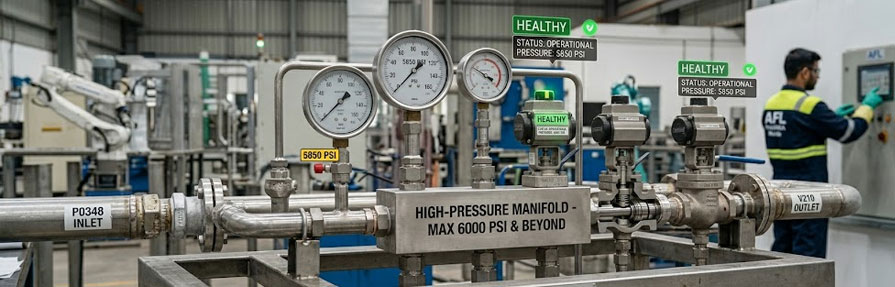
High-pressure environments place extreme demands on every component within an instrumentation system. In oil & gas production, chemical processing, power generation, and hydraulic applications, pressures can reach levels where even minor design weaknesses lead to leaks, instrument damage, or serious safety risks. In such conditions, manifold valves are not merely control accessories—they are critical pressure-containing components that directly affect system integrity and personnel safety.
Selecting manifold valves for pressures up to 6000 PSI and beyond requires a different mindset than standard instrumentation selection. Buyers must evaluate pressure containment capability, structural integrity, sealing reliability, and long-term performance under cyclic loading. This guide explains how to think about high-pressure manifold valve selection from a practical, application-driven perspective.
What Qualifies as a High-Pressure Manifold Valve Application?
A high-pressure manifold valve application is defined not only by operating pressure, but by the maximum pressure the valve may experience under all conditions. In many industrial systems, pressure spikes during start-up, shutdown, blocked-in conditions, or hydraulic shock can exceed normal operating levels.
Applications are generally considered high-pressure when:
- Design pressure approaches or exceeds 3000 PSI
- Pressure spikes are unpredictable or severe
- The system involves incompressible fluids (hydraulics)
- Pressure isolation is required for safety-critical maintenance
In these environments, manifold valves must reliably withstand pressure loads without deformation, leakage, or loss of sealing integrity.
Why High-Pressure Manifold Valve Selection Is Different
Manifold valves used in moderate-pressure applications may perform adequately under normal conditions but fail prematurely when exposed to sustained high pressure or repeated pressure cycling. High-pressure environments amplify stresses on valve bodies, stems, seats, and seals.
Key challenges include:
- Elevated mechanical stress on valve internals
- Increased risk of leakage at sealing points
- Sensitivity to material defects or improper machining
- Accelerated wear due to pressure cycling
Because manifold valves isolate pressure instruments, they are often exposed to full line pressure, even when the instrument itself is protected. This makes proper high-pressure selection essential for both safety and measurement reliability.
Understanding Pressure Ratings Beyond the PSI Number
Buyers often focus on a single pressure rating value—such as 6000 PSI—without considering how that rating is defined or applied. In reality, pressure rating must be evaluated alongside temperature, media type, and duty cycle.
Important pressure-related factors include:
- Maximum allowable working pressure
- Pressure-temperature derating
- Transient pressure events
- Blocked-in pressure conditions
- Repeated pressure cycling over time
A manifold valve rated for high pressure at ambient temperature may not perform the same way at elevated temperatures or under rapid pressure fluctuations. Understanding these interactions is critical when selecting valves for extreme environments.
Material and Structural Considerations in High-Pressure Manifold Valves
High-pressure performance depends heavily on valve body material, internal geometry, and manufacturing quality. At elevated pressures, even small imperfections can become failure points.
High-pressure manifold valves typically require:
- High-strength materials with proven pressure performance
- Precision machining to maintain dimensional accuracy
- Robust valve stem and seat design
- Reliable sealing systems capable of withstanding pressure cycling
Material selection is not just about strength—it must also consider compatibility with process media and long-term stability under stress.
Why Hydraulic Systems Demand Special Attention
Hydraulic systems represent some of the most demanding high-pressure environments because they involve incompressible fluids. Pressure changes in hydraulic systems are transmitted instantly, producing shock loads that can stress valve components.
In hydraulic applications, manifold valves must:
- Withstand sudden pressure spikes
- Maintain sealing integrity under rapid load changes
- Support predictable isolation and venting
Failure to account for these conditions can result in leaks, erratic pressure readings, or unsafe maintenance scenarios.
High-Pressure Manifold Valves and Maintenance Safety
In high-pressure environments, maintenance activities carry elevated risk. Manifold valves play a critical role in enabling safe isolation and controlled pressure release before instruments are serviced.
A properly selected high-pressure manifold valve allows technicians to:
- Isolate pressure instruments safely
- Vent trapped pressure in a controlled manner
- Verify pressure relief before disassembly
- Reduce exposure to live pressure during maintenance
This safety function becomes increasingly important as system pressure rises.
Why Oversimplified Selection Leads to Failure
One of the most common mistakes in high-pressure applications is assuming that any valve labelled “high-pressure” is suitable for all high-pressure uses. In reality, high-pressure environments vary widely in terms of pressure behaviour, temperature, media, and duty cycle.
Oversimplified selection can result in:
- Valves operating at the edge of their design limits
- Increased maintenance frequency
- Reduced service life
- Elevated safety risk
High-pressure manifold valve selection must be deliberate, conservative, and grounded in a full understanding of operating conditions.
Preparing for High-Pressure Manifold Valve Evaluation
Before selecting a manifold valve for pressures up to 6000 PSI or beyond, buyers should clearly define:
- Maximum design and transient pressures
- Operating temperature range
- System media and cleanliness
- Frequency of pressure cycling
- Maintenance and calibration requirements
This preparation lays the groundwork for identifying manifold valve designs and configurations that can perform reliably under extreme pressure conditions.
Setting the Stage for Identifying the Best Options
Not all manifold valves are suited for high-pressure service. The best options are those that combine appropriate pressure rating, structural robustness, and predictable maintenance behaviour.
In the next section, these principles will be applied to identify which manifold valve configurations and selection criteria are best suited for high-pressure environments, including applications approaching or exceeding 6000 PSI.
What Makes a Manifold Valve Suitable for 6000 PSI & Beyond
Not all manifold valves marketed as “high-pressure” are suitable for extreme pressure environments. True high-pressure performance depends on a combination of pressure rating, structural integrity, sealing reliability, and predictable behavior under cyclic loading.
For applications approaching or exceeding 6000 PSI, the manifold valve must be able to:
- Contain full system pressure without deformation
- Maintain leak-tight sealing under pressure cycling
- Withstand transient spikes beyond normal operating pressure
- Provide safe, controlled isolation and venting
Valves that meet only nominal pressure requirements but lack structural robustness often fail prematurely in these environments.
Pressure Rating Is Necessary—but Not Sufficient
Pressure rating is the first filter in high-pressure selection, but it is not the only one. Buyers must look beyond the headline PSI number and evaluate how the rating is achieved and sustained.
Key considerations include:
- Whether the rating applies across the full temperature range
- How the valve performs under repeated pressure cycling
- Margin between operating pressure and maximum allowable pressure
- Valve behavior during blocked-in conditions
A manifold valve operating continuously near its maximum rating is at greater risk of fatigue, leakage, or seal degradation over time.
Structural Design and Material Strength in High-Pressure Valves
At high pressure, valve body strength and internal geometry become critical. The ability to withstand internal forces without distortion depends on both material properties and design precision.
High-pressure manifold valves typically feature:
- High-strength alloy or stainless steel bodies
- Thick-wall construction to resist deformation
- Precision-machined internal passages
- Robust stem and seat interfaces
Material selection must also consider compatibility with process media, especially in oil & gas and chemical environments where corrosion or contamination may be present.
Configuration Choice for High-Pressure Applications
Configuration selection in high-pressure environments is driven by safety and maintenance requirements, not convenience.
- 2-way manifold valves are used in high-pressure systems only when basic isolation and venting are sufficient and calibration requirements are limited
👉 https://pioneerfitting.com/2-way-manifolds-valves/ - 3-way manifold valves are preferred where pressure equalization is required, such as differential pressure measurement under high pressure
👉 https://pioneerfitting.com/3-way-manifolds-valves/ - 5-way manifold valves are most commonly specified for high-pressure and safety-critical applications, as they provide full isolation, equalization, and dual venting
👉 https://pioneerfitting.com/5-way-manifolds-valves/
In extreme pressure environments, the ability to vent pressure safely from both sides of the instrument is often a non-negotiable requirement.
High-Pressure Manifold Valves in Hydraulic Systems
Hydraulic systems represent some of the harshest conditions for manifold valves because pressure changes are transmitted instantly through incompressible fluid. Even brief pressure spikes can exert enormous force on valve components.
In hydraulic applications approaching 6000 PSI:
- Valve bodies must withstand sudden shock loads
- Sealing systems must maintain integrity under rapid pressure changes
- Venting must be controlled to avoid unsafe discharge
Manifold valves in hydraulic systems must therefore be selected conservatively, with attention to both pressure rating and dynamic response.
Why Maintenance and Calibration Drive High-Pressure Selection
High-pressure systems amplify maintenance risk. Improper isolation or uncontrolled venting can lead to serious injury or equipment damage. Manifold valves play a central role in managing this risk.
In high-pressure environments, manifold valves must:
- Allow predictable, gradual pressure release
- Enable technicians to verify isolation before servicing
- Maintain sealing performance after repeated operation
Configuration and design choices that simplify safe maintenance often outweigh minor cost differences in high-pressure applications.
Avoiding False Economy in High-Pressure Valve Selection
A common mistake is attempting to reduce cost by selecting manifold valves that technically meet pressure requirements but lack proven performance in extreme conditions. This often results in:
- Increased inspection and maintenance frequency
- Premature replacement
- Elevated safety risk
- Higher total lifecycle cost
In high-pressure service, conservative selection typically results in lower overall cost and greater operational confidence.
Using a Structured Product Range to Match High-Pressure Needs
Access to a clearly organized manifold valve range allows buyers to match configuration and pressure capability to application demands without compromise.
Reviewing a centralized manifold valve category helps buyers identify suitable options for high-pressure service:
👉 https://pioneerfitting.com/manifold-valves/
For consistency across projects and pressure classes, reviewing the full instrumentation product range also supports aligned selection:
👉 https://pioneerfitting.com/product-range/
Preparing for Final Validation in Extreme Pressure Applications
Once pressure rating, configuration, and material suitability are aligned, final validation with engineering and maintenance teams ensures the selected manifold valve will perform safely over its full service life.
This disciplined approach separates truly high-pressure-capable manifold valves from those suitable only for moderate service.
Validating Manifold Valves for Extreme Pressure Applications
In high-pressure environments, final validation is as important as initial selection. A manifold valve that appears suitable on paper must be verified against real operating and maintenance conditions, especially when pressures approach or exceed 6000 PSI.
Buyers should validate:
- That the valve pressure rating exceeds maximum design and transient pressure, not just operating pressure
- That sealing performance is reliable after repeated pressure cycling
- That isolation and venting can be performed gradually and predictably
- That maintenance personnel can verify pressure relief before disassembly
This validation step is critical in oil & gas, chemical, and power plant environments where pressure-related failures carry serious safety and compliance consequences.
High-Pressure Buyer Checklist – 6000 PSI & Beyond
Use this checklist to confirm manifold valve suitability before issuing a purchase order for high-pressure service.
High-pressure selection checklist:
- Confirm maximum system pressure, including spikes and blocked-in conditions
- Select a pressure rating with adequate safety margin
- Match valve configuration to application criticality:
- 2-way → limited, non-critical isolation
- 3-way → differential pressure equalization
- 5-way → safety-critical, high-pressure isolation and venting
- Verify material compatibility with process media
- Consider pressure cycling frequency and fatigue risk
- Ensure controlled venting capability for safe maintenance
- Validate selection with engineering and maintenance teams
Following this checklist reduces the risk of leakage, premature failure, or unsafe maintenance in extreme pressure systems.
Frequently Asked Questions
What pressure rating is considered high-pressure for manifold valves?
Applications approaching or exceeding 3000 PSI are considered high-pressure, with 6000 PSI and above requiring special attention.
Are all 6000 PSI manifold valves suitable for extreme environments?
No. Pressure rating alone is not enough—design, materials, and sealing reliability also matter.
Why are 5-way manifold valves preferred in high-pressure systems?
They allow full isolation, equalization, and controlled venting, improving safety during maintenance.
Do hydraulic systems require special high-pressure manifold valves?
Yes. Hydraulic systems experience sudden pressure spikes that demand robust valve design.
Is oversizing a safe approach for high-pressure valves?
Not always. Oversizing can increase dead volume and does not guarantee better pressure performance.
Can high-pressure manifold valves reduce maintenance risk?
Yes. Properly selected valves allow safe pressure isolation and predictable venting before servicing.
Reviewing Manifold Valve Options for High-Pressure Service
After validating pressure and safety requirements, buyers can review available manifold valve configurations suited for extreme pressure environments.
Manifold valve overview:
👉 https://pioneerfitting.com/manifold-valves/
High-pressure configuration references:
- 2-way manifold valves
👉 https://pioneerfitting.com/2-way-manifolds-valves/ - 3-way manifold valves
👉 https://pioneerfitting.com/3-way-manifolds-valves/ - 5-way manifold valves
👉 https://pioneerfitting.com/5-way-manifolds-valves/
For system-wide consistency across pressure classes, buyers may also review the complete instrumentation offering:
👉 https://pioneerfitting.com/product-range/
Summary – Choosing the Best Manifold Valves for Extreme Pressure
High-pressure environments magnify every weakness in valve design and selection. The best manifold valves for pressures up to 6000 PSI and beyond are those that combine adequate pressure rating, structural robustness, reliable sealing, and predictable maintenance behaviour.
By applying a conservative, application-first approach, buyers can reduce safety risk, extend service life, and ensure reliable pressure measurement in even the most demanding industrial conditions.